


8 Out of the World’s Top 50 Universities in QS Rankings 2026 Are Chinese

Updated: May 17
China Is No Longer Just an Alternative — It Is Becoming One of the World’s Leading Study Destinations?
For many years, when students and parents in Pakistan talked about studying abroad, the conversation was almost always limited to the United States, the United Kingdom, Australia, or Canada. China was often misunderstood. Some people looked at it only as an affordable option. Others believed it was only suitable for medicine or engineering. But the global reality today is very different.
The world has changed.
China is now home to some of the best universities on Earth. Its cities are among the most modern anywhere in the world. Its infrastructure development has reached a level that even many developed countries openly admire. Its research output is growing at an extraordinary speed. And most importantly for international students, China is offering high-quality education at a cost that is still realistic for middle-class families.
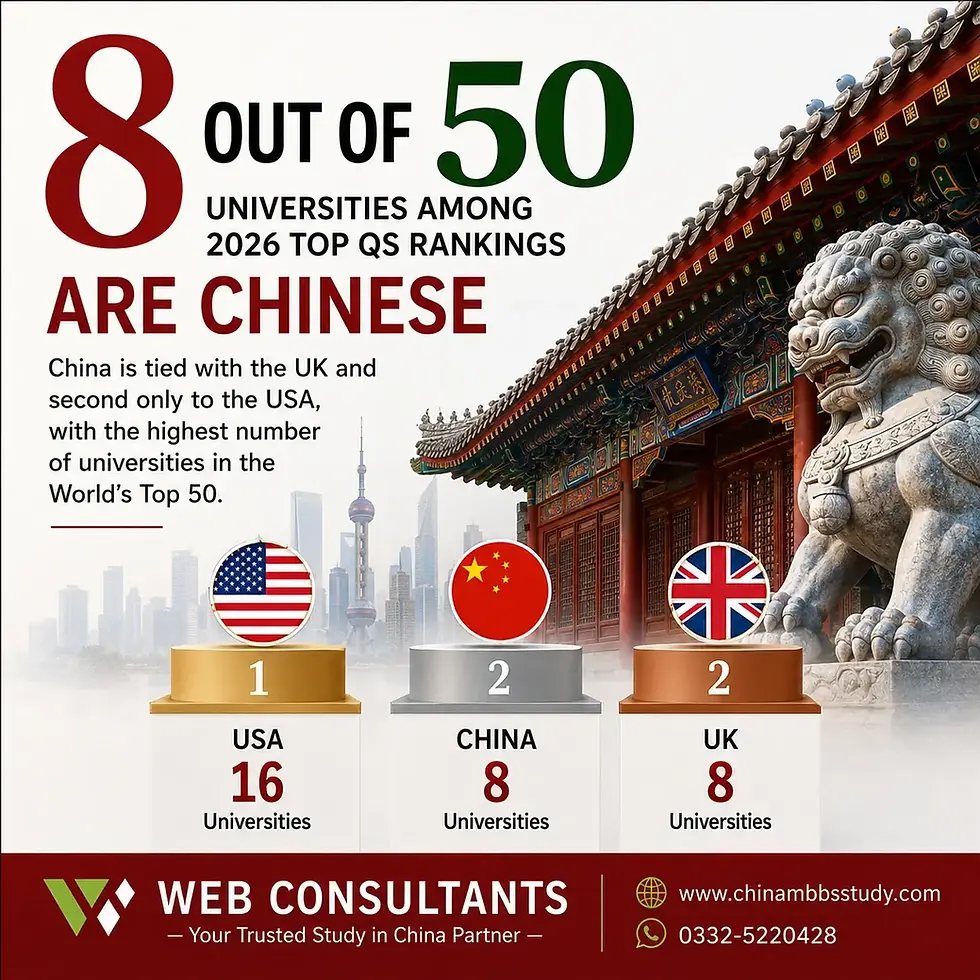
The latest QS World University Rankings 2026 once again proved something very important: China is now one of the strongest higher education powers in the world. According to QS Rankings 2026, China has 8 universities among the world’s Top 50 universities. This places China tied with the United Kingdom and second only to the United States in representation among the global Top 50 universities.
This is not a coincidence.
This is the result of decades of investment in education, research, innovation, science, technology, and infrastructure.
And students in Pakistan need to understand one thing very clearly: the world’s perception of Chinese universities has changed dramatically. Employers, researchers, industries, and governments around the world are now taking Chinese institutions extremely seriously. The rise of Chinese Universities in QS Rankings 2026 clearly shows how China has become one of the world’s leading destinations for higher education.
8 Out of the World’s Top 50 Universities in QS Rankings 2026 Are Chinese - A Major Global Achievement
The universities from Mainland China and Hong Kong that entered the global Top 50

include:
Peking University — Global Rank #14
Tsinghua University — Global Rank #17
Fudan University — Global Rank #30
Shanghai Jiao Tong University — Global Rank #47
Zhejiang University — Global Rank #49
The University of Hong Kong — Global Rank #11
The Chinese University of Hong Kong — Global Rank #32
The Hong Kong University of Science and Technology — Global Rank #44
These are not ordinary institutions.
These universities are producing globally recognized research, collaborating with major industries, attracting international faculty, and competing directly with elite institutions from the United States and Europe.
What makes this even more remarkable is that China achieved this growth within a relatively short period of time. A few decades ago, very few Chinese universities were internationally discussed outside Asia. Today, universities like Tsinghua and Peking University are competing with institutions such as Stanford, Oxford, Cambridge, and MIT in multiple academic fields.
That is a massive transformation.
Why QS Rankings Matter
Some people ask whether rankings are really important.
The answer is YES — but only when the rankings are internationally recognized and based on multiple academic indicators.
QS World University Rankings evaluate universities using factors such as:
Academic reputation
Employer reputation
Research impact
Faculty-to-student ratio
Internationalization
Sustainability
Global academic influence
This means universities cannot simply “buy” their way into rankings. Consistent research quality, international collaborations, citations, academic output, and graduate employability all matter.
China’s rise in these rankings reflects something deeper: Chinese universities are becoming globally influential institutions.
Why China’s Investment in Education Is Transforming Global Universities
One thing that many people outside China do not fully realize is the sheer scale of China’s investment into higher education.
China did not improve its universities accidentally.
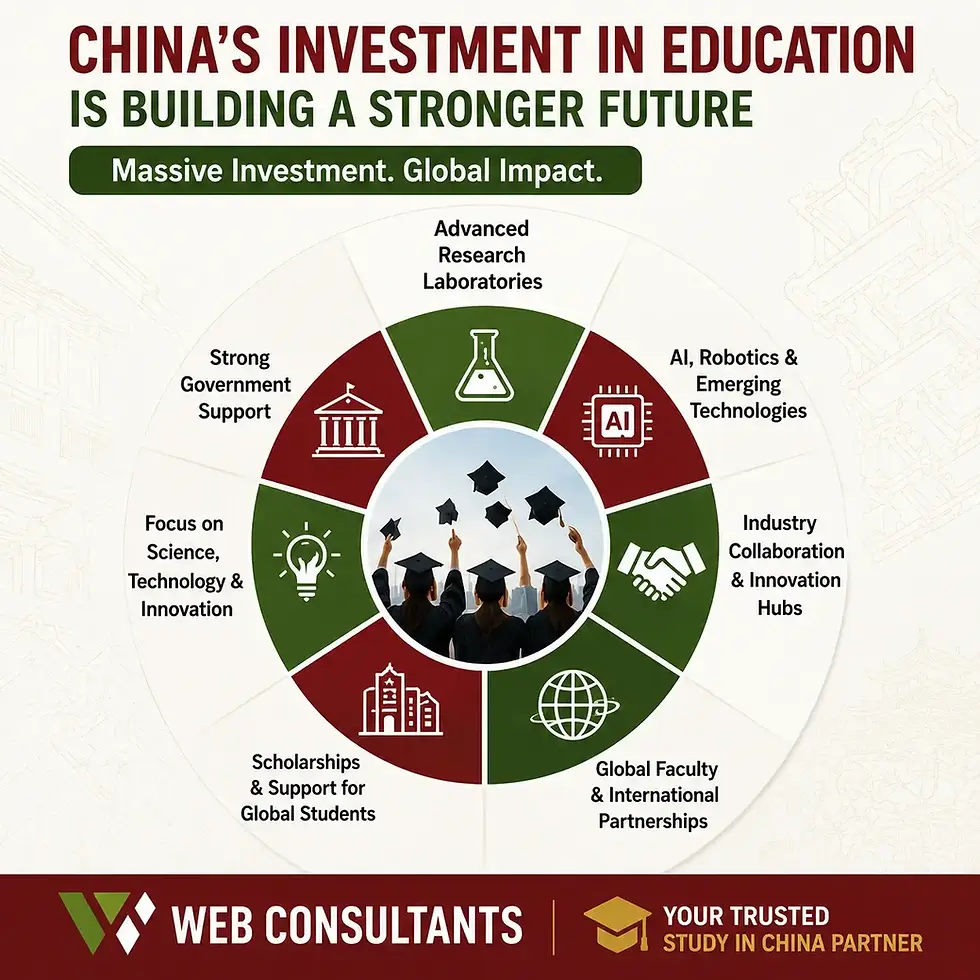
The Chinese government invested heavily into:
Research laboratories
Artificial intelligence
Biotechnology
Medical sciences
Engineering innovation
Semiconductor technology
Aerospace research
Robotics
Green energy
Smart manufacturing
Universities in China today are deeply connected with industry and technology development.
Students are not only studying theory. In many universities, students are exposed to advanced laboratories, real industrial collaborations, innovation hubs, startup ecosystems, and modern research facilities.
This is especially important for students pursuing:
MBBS / Clinical Medicine
Engineering
Computer Science
Artificial Intelligence
Biotechnology
Pharmacy
Data Science
Business and Finance
Environmental Sciences
China is rapidly becoming one of the global centers of innovation. The strong performance of Chinese Universities in QS Rankings 2026 reflects decades of investment in education, research, and innovation.
China’s Modern Infrastructure and Why It Impresses International Students
Now let us address an important point honestly and realistically.
Many people claim that China’s infrastructure is better than the United States and the United Kingdom. Is that actually true?
The answer is nuanced.
In several areas of modern public infrastructure, especially transportation and urban development, China has undeniably advanced at an extraordinary speed and scale. However, it is important not to exaggerate.
China does not surpass the US or UK in every category. The United States still leads globally in many areas such as elite research ecosystems, private-sector innovation, venture capital, and top-end technology companies. The UK remains globally respected in academic traditions, finance, law, and historic institutions.
A Personal Experience That Changed My Perspective About China - Dr. Malik Shafiq Khalil
I still remember an experience from 2007 that completely changed the way I looked at China.
It was during the Chinese New Year period in Jinan. I had attended an international conference, and one evening the organizers invited all foreign participants for a dinner gathering.
That very morning, two women from Australia had just arrived in China for the first time. During dinner, one sat to my right and the other to my left. Surprisingly, the very first thing they said to me was:
“Wow… China is amazing.”
At that time, their reaction genuinely surprised me.
Coming from Pakistan, many of us traditionally viewed countries like Australia as far more developed than Asian countries. And back then, China was still perceived very differently internationally compared to today.
Curious, I asked them what impressed them so much.
Their response stayed in my mind for years.
They said:
“Australia is nothing like this. Look at their skyscrapers, their roads, their infrastructure…”
What made this even more surprising was that we were not even in Beijing or Shanghai. We were in Jinan.
That conversation made me realize something important: sometimes our perception of countries is based more on old assumptions than reality.
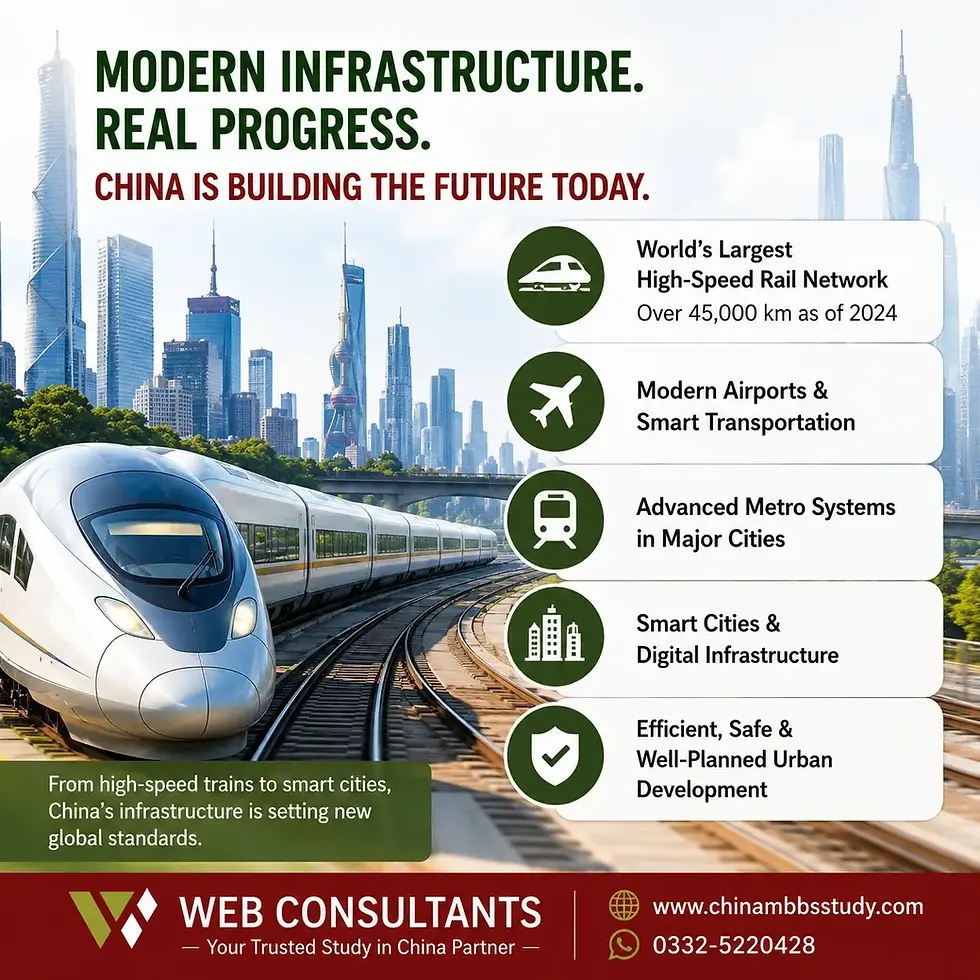
But when we specifically talk about modern infrastructure development, urban transportation systems, high-speed rail, airport connectivity, smart cities, and large-scale modernization, China has achieved something remarkable.
China now has the world’s largest high-speed rail network by a massive margin. Reports show China’s high-speed rail system exceeded 48,000 km by the end of 2024, with expansion continuing further.
By comparison, the United States has extremely limited true high-speed rail infrastructure, while the UK’s projects have progressed far more slowly.
Cities like:
Shanghai
Shenzhen
Guangzhou
Hangzhou
Chengdu
Beijing
Chongqing
have metro systems, digital infrastructure, airport systems, and transportation networks that genuinely impress many international visitors.
Anyone who has traveled across major Chinese cities notices several things immediately:
Clean metro systems
Extremely fast trains
Advanced digital payment systems
Efficient transportation
Modern airports
Safe urban mobility
Large-scale urban planning
This does not mean China is perfect. Every country has challenges. But it does mean that many outdated assumptions people still hold about China are no longer accurate.
The Safety Factor: One of China’s Biggest Strengths
Parents in Pakistan naturally worry about safety when sending children abroad.
This is understandable.
One major advantage repeatedly highlighted by international students in China is public safety.
Students often feel comfortable using public transport late at night, walking in major cities, or traveling between provinces using trains and metros.
China’s strong surveillance systems, organized public transport, and strict law enforcement contribute to this environment.
Of course, no country is completely crime-free. But many international students genuinely feel safer in China than in several Western countries.
That matters to parents.
The Cost Advantage Is Still Huge
One of the strongest reasons students choose China is simple: value for money.
Studying in the US or UK has become extremely expensive.
Tuition fees alone can become financially impossible for many families. Add accommodation, transportation, insurance, food, and living expenses, and the total cost becomes overwhelming.
EXPENSE COMPARISON (Annual Average) | CHINA | USA | UK |
Tuition Fees | USD 2,000-6,000 | USD 25,000-70,000 | USD 15,000-90,000 |
Living Expenses | USD 3,000-5,000 | USD 10,000-15,000 | USD 9,000-13,000 |
Total (Approx.) | USD 5,000-11,000 | USD 35,000-85,000 | USD 24,000-103,000 |
China offers something very different.
Students can study in globally ranked universities at a fraction of the total cost.
Even better, many Chinese universities provide:
Partial scholarships
Full tuition scholarships
Accommodation support
Stipends for postgraduate students
For many Pakistani families, this creates an opportunity that otherwise may not exist.
China Is Becoming a Global Research Power
Another major shift happening globally is research dominance.
Chinese universities are publishing enormous amounts of scientific research. In many scientific fields, China is now competing directly with the United States in research output.
This is especially visible in:
Artificial Intelligence
Engineering
Renewable energy
Medical research
Materials science
Robotics
Telecommunications
This matters because strong research environments improve education quality.
Students studying in research-intensive universities gain exposure to innovation, modern laboratories, academic collaborations, and advanced scientific developments.
MBBS in China: Why It Continues to Attract Students
For Pakistani students, MBBS in China remains one of the biggest reasons to choose China.
China has become one of the largest destinations for international MBBS students for several reasons:
Affordable tuition fees
English-medium programs
Modern affiliated hospitals
Advanced medical technology
International student communities
WHO-recognized universities
Large patient exposure
Many Chinese teaching hospitals are extremely advanced and technologically equipped.
Students often gain exposure to large-scale hospital systems, digital medical technologies, and modern diagnostic equipment.
However, students must choose universities carefully when opting to Study MBBS in China.
This is extremely important.
Not every university is equal.
Students should always prioritize:
PMDC-compliant universities
Universities with strong hospital affiliations
Good international student management
Stable academic reputation
Proper English-medium teaching environment
This is exactly why professional guidance matters when selecting a university.
Hear From a Pakistani MBBS Student at Zhejiang University
Many students and parents in Pakistan still wonder what student life in China actually looks like. To provide a real perspective beyond rankings and statistics, here is Zohaib Altaf, a Pakistani MBBS student currently studying at Zhejiang University, sharing his experience about academics, campus life, facilities, and studying MBBS in China.
Zhejiang University is one of China’s highest-ranked institutions (QS Global Rank 49) and is globally recognized for research, innovation, and academic excellence. Many Pakistani students pursuing MBBS in China are now choosing universities that provide strong international exposure, modern hospitals, and advanced educational facilities.
China’s Global Image Has Changed Dramatically
Ten or fifteen years ago, many people viewed China mainly as a manufacturing country.
Today, the world increasingly sees China as:
A technology giant
A scientific powerhouse
A global economic leader
An innovation center
A research hub
A modern infrastructure model
This transformation has directly improved the reputation of Chinese universities.
When global companies see graduates from institutions like Tsinghua University, Peking University, Fudan University, Zhejiang University or HKUST, they recognize those names.
That recognition matters in careers.
Student Life in China Is Often Better Than People Expect
Many students arrive in China with hesitation.
Then they are surprised.
They discover:
Modern campuses
Excellent dormitories
International cafeterias
Fast transportation
Digital convenience
Beautiful city environments
Organized student systems
China is far more technologically integrated than many students initially imagine.
In many cities, daily life is highly digitized:
QR payments
Smart transportation apps
Online delivery systems
Fast internet services
Efficient public services
Students quickly adapt.
And once they adapt, many genuinely enjoy the experience.
China Is Not Just for Weak Students Anymore
This is another misconception that needs to disappear.
There was a time when some people believed students only went to China because they could not enter universities back home.
That perception is becoming outdated very quickly.
Today, many academically strong students intentionally choose China because they understand where the world is heading.
They see:
The rise of Chinese technology
China’s economic power
Strong engineering programs
Research opportunities
Scholarship availability
Growing global influence
In fields like engineering, AI, manufacturing, robotics, telecommunications, and applied sciences, China is becoming one of the most strategically important places to study.
The Hong Kong Advantage
Hong Kong universities deserve special mention.
Institutions like:
The University of Hong Kong
The Chinese University of Hong Kong
HKUST
have maintained extremely strong global reputations.
These universities combine:
International academic environments
English-medium education
Strong research output
Global faculty
International student populations
For students seeking an East-meets-West educational environment, Hong Kong offers something unique.
The Reality About Employment After Graduation
Students often ask:
“Will my degree from China be respected?”
The answer depends heavily on:
Which university you attend
Your own academic performance
Your skills
Your professional development
A degree alone is never enough anywhere in the world.
However, degrees from strong Chinese universities are increasingly respected globally.
Employers today care about:
Skills
Competence
Experience
Communication
Technical ability
Problem-solving
Students who develop themselves properly during university years can perform extremely well after graduation. China’s Future Looks Strong
One reason students are increasingly choosing China is because they see long-term global trends.
China is expected to remain one of the world’s largest economies for decades.
Its influence in:
Technology
Trade
Manufacturing
AI
Renewable energy
Science
Transportation
continues to grow.
Studying in a country at the center of global economic growth creates opportunities.
Students gain:
International exposure
Cross-cultural understanding
Language opportunities
Industry connections
Research access
These experiences matter in the modern world.
Final Thoughts
The global education landscape is changing rapidly.
China is no longer simply an affordable alternative.
It is now becoming one of the world’s leading education destinations.
The QS World University Rankings 2026 clearly demonstrate this reality. Having 8 universities among the global Top 50 is not a small achievement. It places China alongside the United Kingdom and behind only the United States in representation among the world’s elite universities.
But beyond rankings, what truly matters is the complete picture:
Modern infrastructure
Technological advancement
Research investment
Global academic rise
Affordable education
Safety
International opportunities
Students today must think beyond old stereotypes.
The world is changing fast.
And China is now firmly positioned as one of the major centers of global education, innovation, and opportunity for the next generation.


Comments